
Music of All Americans
A Social Studies Residency by Jeff Newell’s New-Trad Octet
Summary
A six-week residency which focuses on cultural blending as seen through the lives of several influential American musicians and how the musical traditions they represent grew out of and influenced American History.This program has been funded by a regrant program of the Arts in Education Program of the NY State Council on the Arts, administered by BRIC Arts|Media|Bklyn and the Brooklyn Arts Council (BAC) in 2007, ’08 & ‘09 and by Doris Duke/Chamber Music America Residency Partnership Grants in 2009 & 2011
Shared Educational and Artistic Goals and Expected Student Outcomes
American music, artistic process, & the effect of history on culture are focus areas of the residency. Our goal is to spark a passion for American music and history in students through unique and imaginative teaching. We also wish to foster critical thinking through close observation & comparative analysis as students listen to music for melodic & rhythmic themes, form, and narrative. In discussion, participants are guided to thoughtful response relative to emotion, context, and a feeling of physical motion. We work to give students an increased awareness of their own cultural history and its place in our broader national history, giving them a stronger sense of identity and belonging within the community.
Art and Non-Art Curricular Areas of Focus
NYS Art Learning Standards 1, 3, & 4 are addressed
in the project through listening, analysis, & performance.
Students respond critically to various works & idioms and
understand the personal and cultural forces that influence
musical development. Social studies curriculum is also
targeted, touching on Westward Expansion, Immigration, and the Civil War era in American history. Poetic form, economy, & rhyme scheme study will support the Language Arts curriculum as students analyze and write blues lyrics. In these ways New York State Common Core State Standards are addressed throughout the residency.
Student Activities
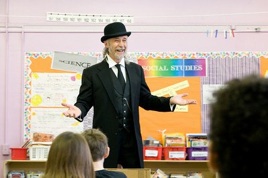
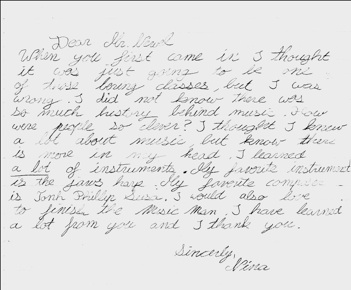
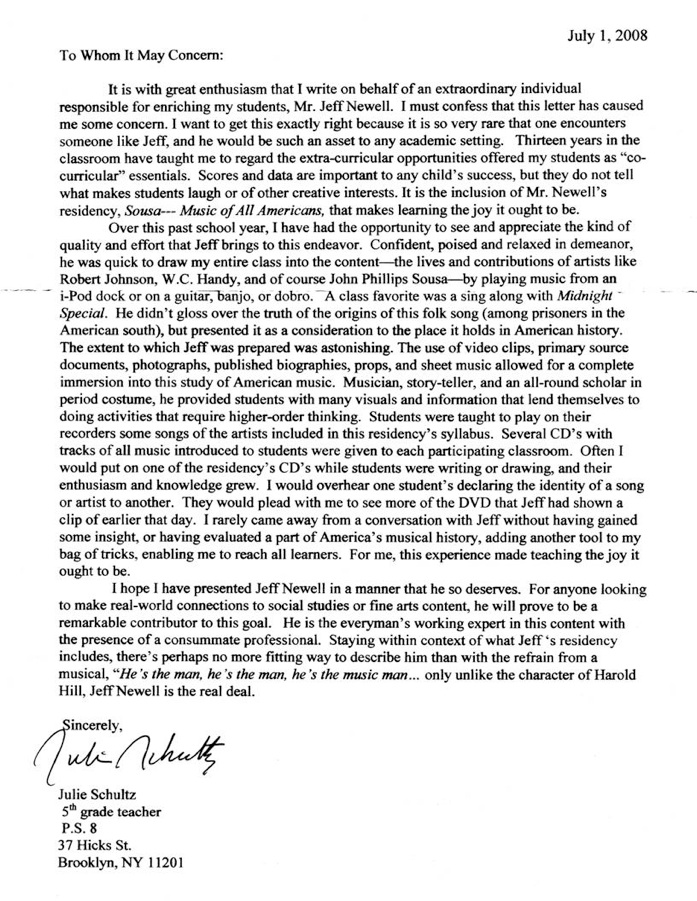
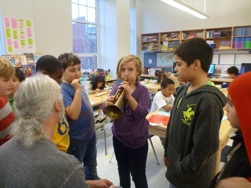
In addition to witnessing in-class performances by highly skilled musicians, students explore music and history through a collection of artifacts provided in the classroom. Hands-on experiences with antique brass instruments, jaw harps, cotton plants, etc.
bring history alive for young people.
Photo by Nathalie Schueller
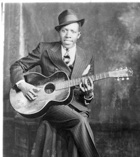
Robert Johnson and other blues artists we study are an inspiration to students.
Here you see:
Howlin’ Otto
&
Blind Lemon Daniel
playing “The Brooklyn Blues”
at a culminating event.
Students have personal music making experiences by assembling and playing two-stringed "Diddley Bows,"
the home-made instrument of African origin which served as Robert Johnson's first guitar. At a culminating concert event, students accompany themselves on blues songs they have written in class that reflect their personal experience.
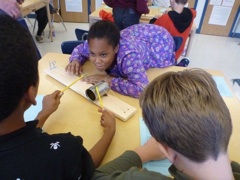
Photo by Melissa Browning
Photo by Melissa Browning